On 3 June our STRIDE team from the University of Hertfordshire took two ROBOTIS OP3 humanoid robots to the QEII Conference Centre in Westminster, for Creating a Scientific Superpower, the Oxford–Cambridge Supercluster Board's annual conference, now in its fifth year.
The room was mostly government, industry, investment and academia. Very few roboticists. That changes the job: nobody is there to read your loss curves, and a robot that stands still is just furniture.
What we brought
Two OP3s, and a set of demos covering the four strands the group works on:
- Reinforcement learning: motion learned by attempting it in simulation, thousands of times over, rather than scripted joint by joint.
- DeepMimic-based motion generation: reference motion given to the learner as a target, so what comes out resembles the real movement instead of the strange, technically-optimal gaits that pure RL likes to invent.
- Sim-to-real transfer: the gap between a policy that works in simulation and one that works on hardware, where actuators heat up, latency is real, and the floor is never as flat as the one in the simulator.
- Perception: the robot working out what is around it and where it is, which is the part I work on.
Any one of those is a research problem on its own. Standing them up together, on real hardware, in a public hall, is a different problem again.
What I actually did
I was not the one presenting. My day was the layer underneath that, and it started well before the doors did: getting both robots built up, powered, calibrated and running through their routines until the sequence was reliable rather than merely possible.
Once the floor opened, my job was uptime. I stayed on the robots for the whole day, watching for the small signals that come before a failure, and ready to step in and fix it when something did go wrong. A demo that has to run once, in a lab, with the team watching, and a demo that has to run all day in front of strangers are two different engineering problems. The second one is mostly about recovery: how fast can you get back to a working state, without the crowd noticing the gap.
I also spent a lot of the day talking. Anyone who stopped and asked got the explanation: what the robots were doing, why it was hard, and what the research is actually for. Getting that pitch right for a non-specialist audience turned out to be its own skill, separate from the one that put the robots on the table. You have about fifteen seconds before someone decides whether this is science or a toy.
Two screens ran alongside the robots, and they did different jobs. The slide deck I had prepared went up on the TV from the team's laptop, and that one plays to the room, to everyone walking past who hasn't stopped yet. My own laptop stayed open on the STRIDE website, and that one plays to the person actually standing in front of you: when someone asked what else the group had done, the answer was a scroll away rather than a promise to send a link afterwards. Making sure the deck stayed up and on the right thing until the end of the day was part of the job too.
Where my own work fits
The perception strand is where my research sits. On the OP3 I work on probabilistic ball tracking: a particle filter that keeps a belief about where the ball is even when the robot cannot see it, so it can recover the target after occlusion or loss of contact rather than falling back to an uninformed scan. Write-up here: OP3 Probabilistic Ball Tracking.
Seeing it in a hall full of people who fund and shape science, rather than on a lab bench, is a useful correction. The problems that matter to a visitor are not always the ones that matter in the literature.
The team
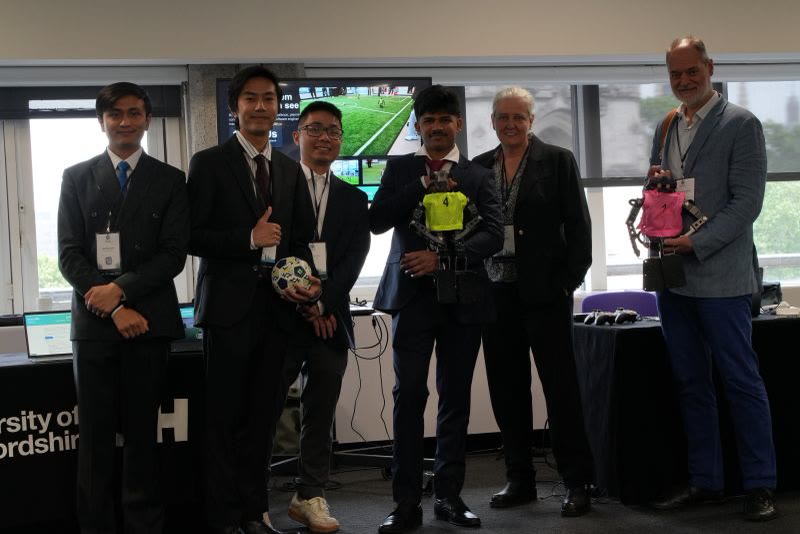
Thanks to Karen Archer, who led the day and put us in the room, and to Athul Krishna Renjith, Quang Nam Phi and Amit Shakya. Two humanoids ran all day and went home in one piece, which is more than can be said for most demo days.